XXXTentacion, born Jahseh Dwayne Ricardo Onfroy, was a trailblazing artist whose raw, emotive sound paved the way for the emo rap and SoundCloud rap movements. His brief life was tragically ended in a botched robbery in Deerfield Beach, Florida, when he was shot and killed on June 18, 2018. His death at the tender age of 20 shocked the music community, with fans and relatives left in shocked despair.
XXXTentacion’s son has a photoshopped image of him with his late father—whom he never got to meet—as his phone wallpaper 💔 pic.twitter.com/8QXDufIQac
Seven months later, his girlfriend, Jenesis Sanchez, gave birth to their son, Gekyume, on January 26, 2019. The name, meaning “a different state” or “next universe of thought,” was selected by the rapper before his death, showing his artistic flair. Today, as a young boy growing up in the public spotlight, with a father whose fame is long-reaching, Gekyume is surrounded by efforts at keeping XXXTentacion’s memory alive.
Jenesis Sanchez has taken on the role of preserving her son’s connection to his father. In a 2019 interview with WPLG Local 10, she expressed her determination to share stories and memories with Gekyume, saying,
“I want him to know everything about his dad.”
Alongside her, XXXTentacion’s mother, Cleopatra Bernard, reinforces this bond by sharing glimpses of Gekyume’s life on social media, often highlighting his resemblance to his father.
The photoshopped photograph in Gekyume’s phone, likely created by a family member or a hardcore fan, gives him a material link with XXXTentacion. It creates a scene that never was, a father and son, bridging the gap left by loss. That this is something a child as young as six does, by making it his wallpaper, is revealing, indicating a mix of love, interest, and pride in a father he has heard about from others’ descriptions.
Sleepy Hallow’s “A N X I E T Y” followed an unusual trajectory. Released September 15, 2023, as a standout single from his Boy Meets World album, Doechii’s feature went nearly two whole years without much notice before erupting in March 2025. A viral trend on TikTok took over from there, and the song eventually achieved the fame that was long overdue, leaving one wondering: what took so long?
Produced by Great John, “A N X I E T Y” is itself a sample tapestry, borrowing from Doechii’s earlier track “Anxiety”, which samples Gotye’s chart-topper in 2011, “Somebody That I Used to Know.” This multi-layering is what gives the song a richness that is uniquely its own, pairing contemporary-day hip-hop with flashes of earlier melodies. Underneath all this, however, is a raw expression of Sleepy Hallow’s internal turmoil with his mental health, something that would go on to touch the lives of millions.
When “A N X I E T Y” came out, it didn’t light the charts up. It made it to number 52 in September 2023, getting a respectable nod but never quite reaching blockbuster status. The critics were all about the reflective lyrics and the silky smooth interaction between Sleepy Hallow and Doechii, but the public wasn’t really interested. The song lingered in the background for a while, a sleeper hit waiting in the wings.
The heart of “A N X I E T Y” lies in its words. Sleepy Hallow doesn’t hold back, vividly depicting his struggles with lines like
"feel like I'm stuck in a maze"
and
"sometimes I feel like a slave to my feelings."
These lyrics capture a sense of being trapped, a sentiment he unpacked in an interview with Genius. “It’s like therapy for me,” he said, describing how the song became an outlet for his anxiety and inner demons.
Dig deeper, and the track reveals clever metaphors. Take
"free all my n****s, the Harriet way,"
a nod to Harriet Tubman’s legacy of liberation, hinting at Sleepy Hallow’s yearning to break free from mental and societal chains. Or consider
"Jacques Cousteau with the wave,"
possibly likening his emotional journey to the famed explorer’s dives into uncharted waters. These layers add richness to the song, inviting listeners to connect on multiple levels.
Load YouTube Video
So, what was the cause for the long-overdue popularity boost for the song? The answer arrived in March 2025, when “A N X I E T Y” became a viral hit on TikTok. The song’s haunting beat and lyrics that spoke universally were the soundtrack for countless videos, making it a cultural phenomenon overnight. This was no fluke; TikTok has a track record for resuscitating old songs, as with such songs as Lil Dicky’s “Pillow Talking” in the past. With Sleepy Hallow, the platform was the perfect platform for a second act.
However, the TikTok trend was not the exclusive driving force behind it. In 2025, mental health discussions were louder than ever, with more people sharing their own anxiety experiences. The cultural movement likely made the song more powerful, with the subject matter more relevant than ever. Doechii’s subsequent decision to release her “Anxiety” song back onto streaming platforms stoked the fire, exposing the Sleepy Hallow version to a brand new audience.
Sleepy Hallow’s “A N X I E T Y” shows that sometimes tracks take time to find their people. Its journey from modest introduction to viral sensation is a testament to music’s power to bridge individual struggles with universal truths. With lyrics that speak so directly and a sound that is so emotive, the track is now more than a hit; it is a lifeline for individuals navigating their own mazes. Two years on, and its resonance now sounds louder than ever.
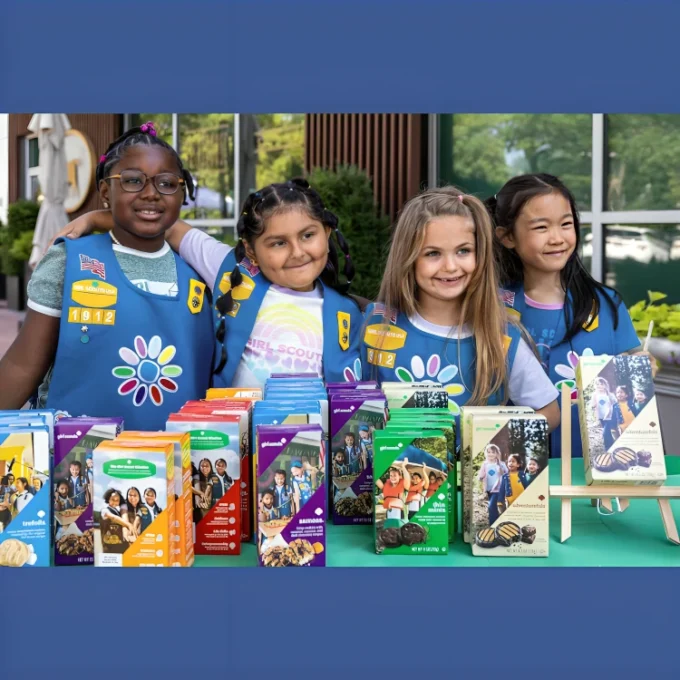
The USA Girl Scouts face a class-action lawsuit alleging that their most popular cookies carry excessive levels of heavy metal and pesticide residues. The lawsuit, filed by March 10, 2025, by resident Amy Mayo in New York, is seeking $5 million in damages and has made cookie makers Ferrero U.S.A. and ABC Bakers joint defendants. The lawsuit has made national headlines, with numerous people questioning food safety and consumer confidence.
The lawsuit is grounded in a 2024 study conducted by consumer advocacy groups GMO Science and Moms Across America. The study tested 25 boxes of Girl Scout cookies from California, Iowa, and Louisiana, and found that 100% of the samples contained at least four out of five heavy metals: aluminum, arsenic, cadmium, lead, and mercury. Additionally, traces of glyphosate, a widely used pesticide, were detected in all tested samples.
Girl Scouts sued after a study allegedly found heavy metals and pesticides in “100%” of sampled cookies. pic.twitter.com/MmI4nHf1uA
Among the products that were analyzed, Thin Mints had the highest level of glyphosate, with Peanut Butter Patties having excessive levels of lead and aluminum. The lawsuit accuses the Girl Scouts of deceiving consumers regarding safety and quality of their cookies, insisting that more specific labeling be done about the composition of these chemicals.
Despite the shocking findings, the study has been strongly criticized. The study is described by critics as non-peer-reviewed, and others argue that it is misleading in measuring food contamination against Environmental Protection Agency (EPA) guidelines for water safety.
Besides, most food scientists note that heavy metals naturally exist in soil and in very minute concentrations in most crops. The presence of such substances does not necessarily mean that the food is a serious health risk.
In response to the scandal, the USA Girl Scouts publicly stated on February 6, 2025, that their cookies were safe for consumption and were compliant with all food safety regulations. They explained that heavy metals naturally occur in soil and that glyphosate is found in most foods as it is heavily used in agricultural production.
These metals are not found in our Girl Scout Cookies, the message said. “All our products meet the strict safety standards set by the FDA and regulatory agencies.”
The lawsuit has ignited heated online discussions. Social media has been flooded with postings, with some asserting that the FDA pulled the cookies from the market, something that has since been debunked. A Forbes article clarified that the lawsuit is indeed made in comparison with EPA water standards and not with FDA food standards, with the additional note that there is currently no official evidence that the cookies are a health risk.
Surprisingly, after having first filed the lawsuit, Amy Mayo tried to dismiss her complaint. But more plaintiffs followed, and the lawsuit remains pending. Lawyers expect that the lawsuit can lead to more stringent labeling laws or increased transparency in food manufacturing.
Even assuming that the lawsuit is valid in food safety, critics note that it is short in scientific evidence in support of such allegations. While the legal battle is in process, consumers now need to decide whether they should be depending on food safety regulators’ assurances or the astonishing findings from outside studies.
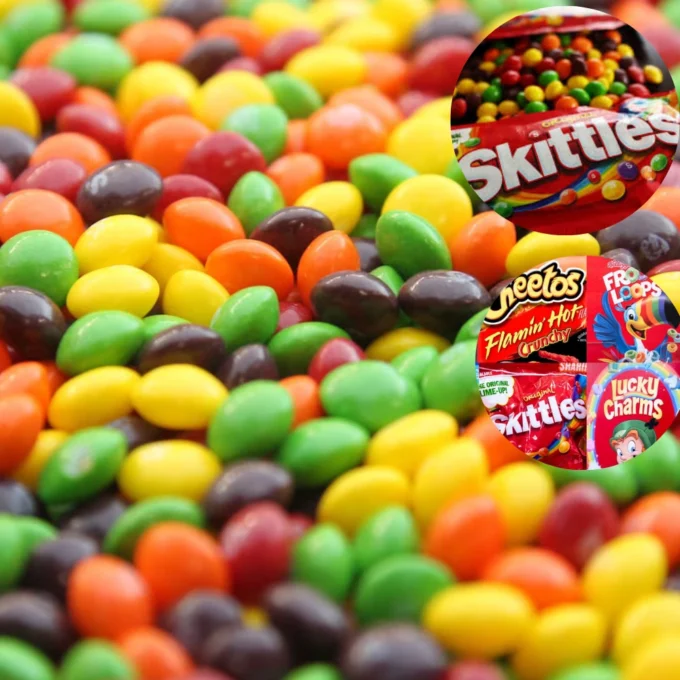
Florida is in the news with a bill that could shake up the snack food market. Senate Bill 560, introduced by State Senator Jonathan Martin, would ban certain chemical additives in food. If this bill were to pass, it would mean the end of America’s favorite snacks, like Skittles, Doritos, and Froot Loops, in their current forms. But what is driving Florida in this direction, and what does it mean for snack lovers?
Florida's new bill could ban Skittles, Doritos, Froot Loops cereal, and other tasty treats 👀 pic.twitter.com/TBQI1AhA2Q
Senate Bill 560 is focused on food safety. The bill is targeting nine chemical additives that various studies link with health risks, especially in children. The bill is already receiving support in the Florida Senate and is set to be made into a law by July 2025. Food producers would, however, be afforded until January 2028 to comply. Companies would be mandated to remove the banned additives or stop selling products with such additives in Florida.
via- Shutterstock
Senator Martin has been vocal about the danger that these chemicals represent.
“There are cancer-causing chemicals. They have no place in our food. Period,”
He wrote in a social media update. His stance is clear: public health is more important than the preservation of snack flavor.
The bill targets nine specific additives, including:
Brominated vegetable oil (BVO) – Used in some beverages, but recently banned by the FDA.
Potassium bromate – A dough enhancer banned in Europe due to cancer concerns.
Propylparaben – A preservative linked to hormone disruption.
Synthetic food dyes – Red dye 3, Blue dye 1, and Yellow dye 5, which some studies suggest may contribute to hyperactivity in kids and potential health risks.
Other preservatives—including benzidine, butylated hydroxyanisole (BHA), and butylated hydroxytoluene (BHT), are used to extend shelf life but have been under scrutiny.
While these chemicals are FDA-approved, Florida lawmakers argue that new research suggests they may be harmful. They point out that many of these additives are already banned in Europe and California and believe Florida should follow suit.
These popular snacks would be taken off the shelves, or reformulated, if this bill is signed into law. Skittles, with their bright colors, include Yellow five and Blue one, both of which would be banned by this bill. Froot Loops and Doritos use dyes that would be forbidden.
That does not mean, however, that such products will disappear forever. When such bans were imposed in Europe, companies devised substitute recipes that did not lose their unique tastes. Manufacturers, in the opinion of some analysts, will reformulate nationally, as opposed to making special editions for Florida.
The Health Debate
The bill is justified by proponents as consumer protection, specifically that of children. Certain additives in question were found in studies to be associated with health issues, such as cancer risk and behavioral symptoms. To illustrate, studies show that Red dye 3, which cosmetics were excluded from using decades ago, is likely unsafe for ingestion as well.
However, not everyone is convinced. Critics argue that the FDA already regulates these ingredients and that removing them from food could limit consumer choices. They also point out that no significant health crises have been directly linked to these additives in the U.S.
What’s Next?
The bill is moving in the Florida Senate and is building support in committee votes. It would be sent to Governor Ron DeSantis for his signature if it is passed by the Senate and House. His stance on the matter is unclear, but since his administration is dedicated to consumer protection, he is likely to sign it.
If the bill is passed, food producers need to act fast. While the deadline for compliance is set for 2028, reformulating favorite snacks is time-consuming and capital-intensive. Producers could decide that it is more practical to comply with Florida regulations across the country than risk losing a huge market.
For now, snack food fans can keep eating their favorite treats. But if this bill is signed, expect ingredient labels to be altered in the future. Whether this leads to healthier snacks, or just substitute artificial alternatives, remains to be seen. One thing is certain – Florida is committed to food safety, and the rest of the country is watching.
Zoe Saldañabecame the first Latina actress to win the Oscar for Best Supporting Actress at the 97th Academy Awards, taking home her first Oscar for her role in Emilia Pérez. But her tearful, behind-the-scenes celebration with her family and powerful acceptance speech was what got people talking.
Zoe Saldaña has captivated audiences for decades with her performances in significant franchise films like Avatar and Guardians of the Galaxy. But this win was a victory of a different kind. In Emilia Pérez, she played attorney Rita Mora Castro, a role that allowed her to show her range and emotional complexity in a film in which she spoke Spanish. Critics lauded her for bringing quiet strength to the role, and the Academy awarded her the golden statue she rightly deserved.
via- Getty images
The moment she emerged onto the stage to accept her Oscar was pure emotion. Tears streaming down her face, she looked out at her mother in the audience and sobbed,
“Mami! Mami! My mom is here. My whole family is here. I am overwhelmed with this honor.”
She also remembered her late grandmother, Argentina Cesse, by talking about the sacrifices made by women in her family that made her path possible.
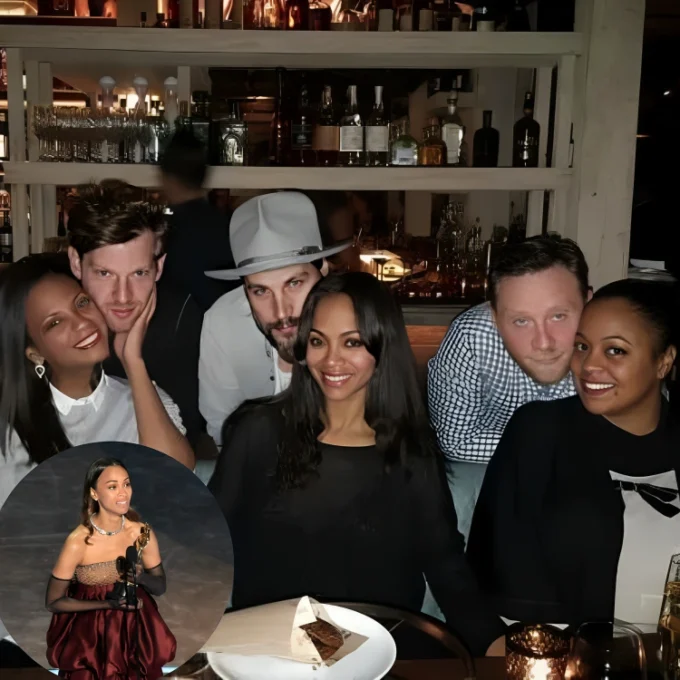
After the ceremony, social media was full of sweet and joyful moments between Saldaña and her family. A now-iconic photo captured her with her sisters, Cisely and Mariel, and their husbands, all beaming with pride. The photo pulled at people’s hearts, with many seeing it as a testament to the family’s role in standing by her during her journey.
Photo of actress Zoe Saldana celebrating her recent oscar win with her sisters and their husbands is going viral 👀
She is the second highest-grossing lead actress in cinematic history, with her movies grossing more than $15 billion worldwide. pic.twitter.com/VgWJeNhZ8E
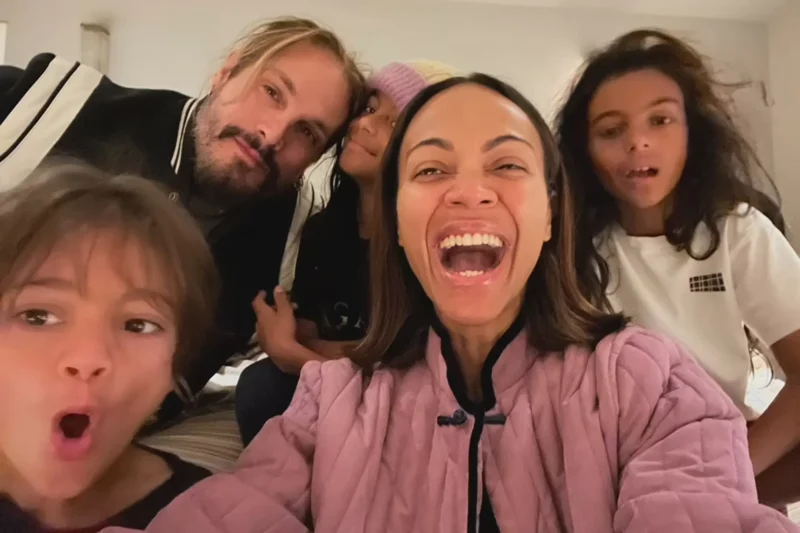
This was far from the first time Saldaña had celebrated milestones with family members. Throughout the awards season, she included her three boys, Cy, Zen, and Bowie, in the celebrations. She FaceTimed them immediately after her Oscar win, drawing them in despite their young age. She also included her husband, Marco Perego-Saldaña, in a tongue-in-cheek shout-out during her acceptance speech by praising his “beautiful hair.”
via- Instagram
Where this Oscar cements her status among serious actresses, Saldaña’s box-office superiority is arguably just as notable. With her movies grossing over $15 billion, she is the second highest-grossing lead actress in movie history. With her work as Neytiri in Avatar and Gamora in the Marvel Cinematic Universe, she has consistently proven that she can lead big franchises to the top.
Her ability to alternate between genres—sci-fi franchises and action films—has made her one of the most bankable actresses in Hollywood. With upcoming Avatar sequels and rumored Marvel cameos, her star power is by no means diminishing.
Apart from the numbers, Saldaña’s win is a victory for Latino visibility in Hollywood. At that moment, she was the first Dominican-American actress ever to win an Oscar, making it very clear that she would be far from alone.
“I am a proud child of immigrant parents from the Caribbean,”
She said, emphasizing the importance of more inclusive stories being told in films.
Through her production company, she has worked to bring more Latino stories to Hollywood so that future generations can have more opportunities in the industry.
Zoe Saldaña’s Oscar win was more than a personal victory—it was a cultural moment. It celebrated the power of family, determination, and visibility. With her continued challenge of demanding roles and testing the boundaries, one thing is sure: her journey is far from over. For now, though, she is soaking up the well-earned moment with her family. And from the viral photo, they’re just as proud as the rest of the world.
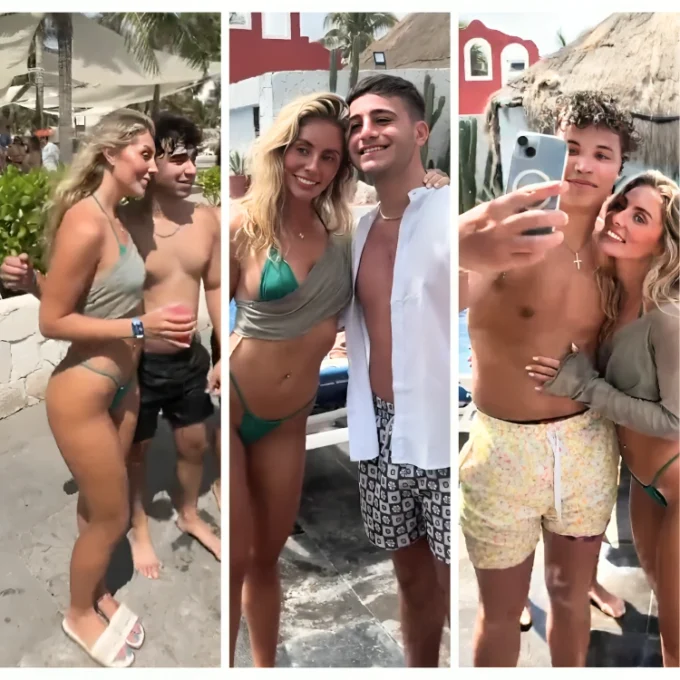
Spring Break in Cancun is known for its vibrant energy, but this year, the arrival of Bonnie Blue has taken the festivities to a whole new level. The adult content creator, who has built a massive following on platforms like OnlyFans, has turned heads and sparked conversations with her bold presence. Her visit during the March Spring Break season has drawn crowds of fans eager to snap photos with her, creating a buzz that’s impossible to ignore.
As the sun dips below the horizon, painting the Cancun beaches in shades of orange and pink, a line stretches outside the Grand Oasis hotel, where Blue is staying. The crowd, largely made up of college students enjoying their break, waits patiently for a chance to meet her. Some are die-hard fans, while others are simply curious about the woman who’s become a social media sensation.
“I’ve followed her online for a while, so seeing her here feels unreal,”
one student, who preferred to stay anonymous, shared.
“It’s wild to have her right in front of me.”
Another chimed in,
“Spring Break is all about letting go, and she’s bringing that vibe in a big way.”
Social media is ablaze with the hashtag #BonnieInCancun, where users post selfies, videos, and opinions about her visit.
Bonnie Blue’s journey to fame is a testament to her entrepreneurial spirit and unapologetic approach. Starting her career as a webcam model in 2023, she quickly transitioned to OnlyFans, where she now boasts a massive following. Her content, often provocative and boundary-pushing, has earned her both admirers and critics. Her success is evident in her recent purchase of a custom Ferrari, a move that underscores the financial gains from her OnlyFans earnings. The car, which she showcased on her social media, stands as a symbol of the rewards she’s reaped from her platform.
Bonnie Blue’s journey towards fame is a testament to her drive and unapologetic nature. She started out as a webcam model back in 2023 before transitioning to OnlyFans, where today she has a gigantic following. Her content, occasionally provocative and edgy, has drawn admirers and detractors. Her victory is evident with the recent purchase of a custom Ferrari, a move mirroring the financial gains from her OnlyFans earnings. The car, which she shared on social media, is a testament to the gains she’s made from her platform.
Reactions to Blue’s presence in Cancun are as varied as the Spring Break crowd itself. Some applaud her confidence and the way she’s embraced her brand, seeing her as a symbol of empowerment.
“She’s living her life on her own terms, and that’s something to admire,”
said one fan. Others, however, question the spectacle she’s created, wondering if it overshadows the traditional Spring Break experience.
“It’s a bit much, even for Cancun,”
remarked a local vendor. Blue, however, remains unfazed. In a statement on her social media, she expressed her excitement for the trip, saying,
“I’m here to have fun and connect with my fans. Spring Break is the perfect time to let loose and enjoy life”
While the Grand Oasis hotel would not comment on Blue’s visit, it has increased the level of security considerably to handle the influx of people. The employees claim the influx is unprecedented with some camping overnight just for the chance to see her. The hotel seems to be handling the attention well with some employees claiming it’s adding a new level of enthusiasm to the Spring Break.
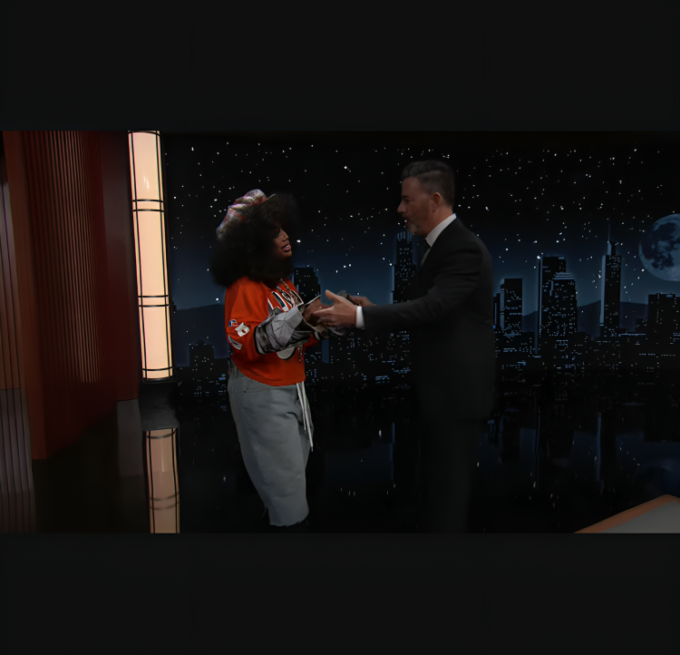
SZAand Kendrick Lamar’s eagerly anticipated Grand National Tour is already the most hyped gig around—so when SZA dropped by Jimmy Kimmel’s show, the discussion soon moved on to the next A-list name: Drake. The five-time Grammy Award winner deftly dodged Kimmel’s questioning about the Toronto stop on her tour with Lamar and stayed light-hearted.
During her March 11, 2025, appearance on Jimmy Kimmel Live!, SZA responded to questions about her highly anticipated Grand National Tour with Kendrick Lamar. Kimmel could not help but reference the drama surrounding their Toronto performance, however, with Lamar’s very public feud with Drake.
Jimmy Kimmel tried to ask Sza about the prospect of Drake coming to her and Kendrick Lamar’s Canada tour stop.
Kimmel asked SZA if she was concerned about performing in Toronto, Drake’s hometown, given the two rap legends’ alleged feud. SZA dodged the question by turning it back around with a joke and replied, “Are you worried?” Kimmel clarified, and SZA replied with a carefree attitude, “I wouldn’t be either. I think it’s going to be so fun.”
Not satisfied with that response, Kimmel pushed further, teasingly referencing Drake without naming him: “What happens when you-know-who shows up?” SZA stayed light-hearted, firing back with, “Who knows who? Who knows you know who know what?” before steering the subject away.
SZA and Kendrick Lamar’s Grand National Tour kicks off April 19, 2025, with the first stop occurring in Minneapolis. A Toronto stop will also happen June 12, 2025, and fans are wondering what might happen in Drake’s hometown. The tour follows their recent collaboration with Lamar’s new release GNX, where SZA is featured on tracks like “Luther” and “Gloria.”
SZA clarified how her and Lamar are coming into the stage production for the tour with a new aesthetic, with the goal of bringing something even better than their Super Bowl Halftime Show. “I think we’re just kinda throwing all the paint against the wall,” SZA told Kimmel. “This is our first time playing stadiums for both of us, so we have to essentially go crazy.”
A lot of the Toronto stop hype revolves around the ongoing feud between Kendrick Lamar and Drake. Their feud intensified in 2024 when Lamar dissed Drake on Like That, his guest verse for the surprise feature on the record by Future and Metro Boomin.
Toronto fans are speculating the Toronto performance by Lamar with SZA might be a power move amidst the ongoing feud. With Toronto’s connection with Drake, questions are being raised about the rapper’s presence—whether live, onstage, or online.
Despite the controversy surrounding them, the two artists are still leading the charts. Kendrick Lamar’s GNX and Drake’s joint venture with PARTYNEXTDOOR are the current top two spots on the Billboard 200, showing their ongoing cultural relevance. SZA is also a powerhouse with her album SOS sitting at No. 4.
Drake also dropped some hints recently regarding imminent plans, informing his fans his “next chapter might make you uncomfortable,” with many speculating about whether his next move will be a diss record or response against Lamar.
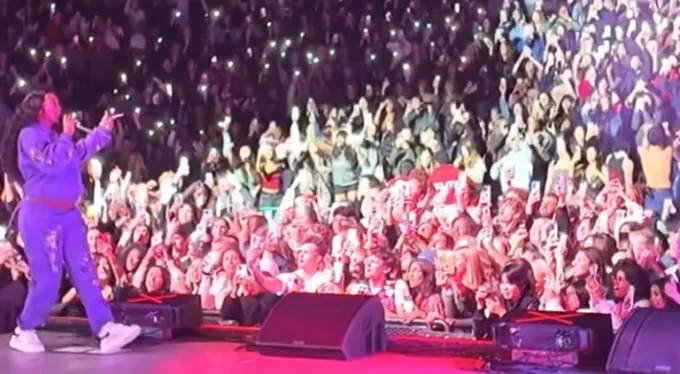
Flo Milli took the crowd by surprise with a San Diego State Universityperformance while nine months pregnant. Despite doctors’ advice to rest before giving birth, the Alabama-born rapper took the stage and delivered a night not soon forgotten. It was the last time she would perform before entering labor and one which would later be described as nothing short of “lit” on social media.
Crowds at SDSU were buzzing with Flo Milli playing some of her biggest hits, including the very popular “Never Lose Me” and “Conceited.” Heavily pregnant and not letting anything stop her, she hit the stage with conviction and determination with no signs of slowing down. The crowd went crazy as she spit bars line after line, showing why she’s one of the most exciting voices around today.
For her part, Flo Milli herself could not help but get excited. After the performance, she went online where she uploaded a series of photos and videos including one where she lies flat for the purpose of undergoing an MRI scan.
“Just performed nine months pregnant. Although the doctor told me not to go, I am glad I still made it happen,” she posted confirming her dedication towards music and the audience.
While others applauded Flo Milli for her commitment and determination, others questioned the sense of performing so late into her pregnancy. Social media was flooded with opposing views. Some applauded her for staying true to herself, others were concerned for her well-being and the well-being of the baby.
“She’s a queen for this! Performing nine months pregnant is next level dedication,” one fan commented.
Others were not happy. “I get that she likes performing but needs to be resting rather than bouncing around the stage this late into her pregnancy,” one user posted.
The debate continues raging with intense arguments from either side. One thing is certain, though, and that’s the fact that Flo Milli remains a power to be reckoned with.
In addition to her performance, Flo Milli also sought parenting advice through social media. She posted lightheartedly on Instagram:
“Girlies, drop some mom tips before I go into labor.”
Responses poured in, including from the R&B singer Monica, who advised, “Keep moving, walking and hydrating! God, your doctors and body will do the rest.” One fan encouraged her to believe in her support group: “Don’t be scared to lean into your village. They’re there for a reason.”
Flo Milli’s pregnancy drama has been as captivating as her music career. She first dropped the hints back in November 2024 by previewing a soon-to-be-released song with a sample from “I’m N Luv (Wit a Stripper).” When fans made their assumptions, she jokingly responded with, “Damn, I can’t be bloated?”
But weeks after the initial discovery, she made the pregnancy public in a different manner, laughing and admitting “I can’t even see my coochie no more. That’s crazy.” She’s posted peeks into her life since while still making headlines within the music industry. Coi Leray and DreamDoll are not the first rappers who are expecting a baby in 2025.
Both just announced their pregnancies, and it’s an exciting time for female rappers. Trippie Redd’s baby with Coi Leray and DreamDoll’s pregnancy reveal have caused a lot of talk, but Flo Milli seems to be the first one who is expected to have the baby.
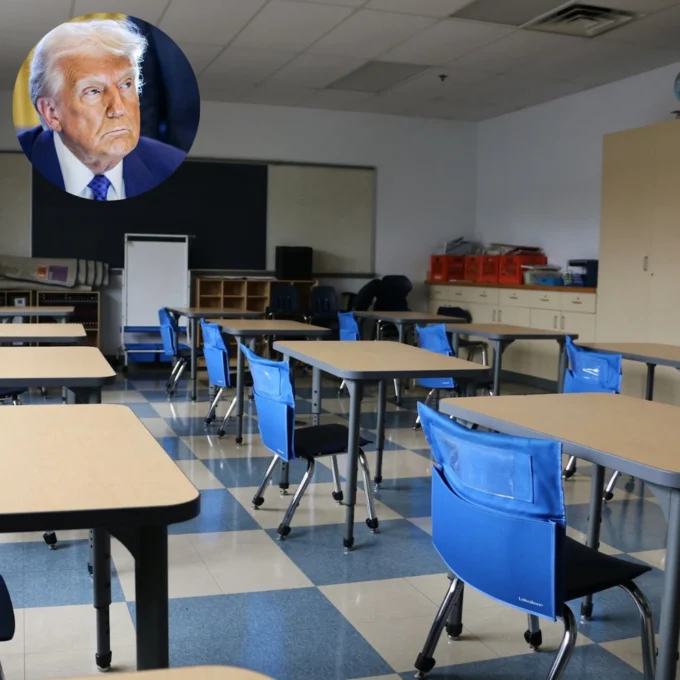
President Trump froze $1 billion of food aid, putting the food supply for millions of poor families at risk. The White Housecharacterized the move as a step necessary to save the government money by claiming the money wasn’t being used effectively. But for the families who rely on the aid, the consequence might be devastating.
The Independent reports that U.S. President Donald Trump has frozen $1 billion in food aid allocated to local schools and food banks to support low-income families. pic.twitter.com/DNgqeMZyvL
The blocked funding was for the Supplemental Nutrition Assistance Program, also known as SNAP, which issues food stamps to more than 40 million Americans. With the cut, most would see their benefits trimmed or delayed. The Center on Budget and Policy Priorities calls SNAP a pillar of anti-poverty policy and says it lifts millions out of hardship every year.
Democratic Senator Elizabeth Warren was not reluctant to give her views, terming the action “short-sighted and heartless.” She warned it would worsen hunger and poverty nationwide. The action was detailed in a Friday White House press release as the government works through the federal budget. Republicans are seeking deeper cuts overall, while Democrats are looking to boost funding for programs like SNAP.
Critics contend reducing food aid is the incorrect method for cutting costs with the economy still weak for many. For low-income families, sources like the Feeding America network are a lifeline, providing people with food through local food banks.
As the battle continues raging over the budget, the future of this $1 billion remains uncertain. The advocates are calling for the legislators to act now, reinstate the funding, and protect the most vulnerable from the worst of the cuts. Meanwhile, millions are left holding their breath for the next step.
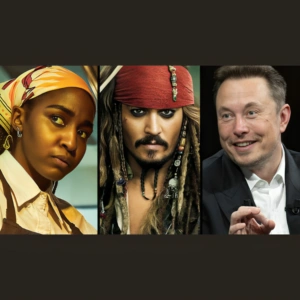
Ayo Edebiri found herself caught right in the middle when the false rumour spread like wildfire that the actress would be stepping into Johnny Depp’s shoes for the Pirates of the Caribbean franchise. The false rumour gained momentum through the month of February 2024 and took a darker turn when tech entrepreneur Elon Musk retweeted it on the now-called-X platform, which brought forth a storm of harassment online against the The Bear actress.
Musk’s tweet “Disney sucks” provoked harassment against Edebiri through racial slurs and death threats. The incident not only put the risks involved with unsubstantiated social media accusations into the limelight but also challenged the role played by prominent personalities towards disinformation prevention.
Ayo Edebiri calls Elon Musk an “idiot” for sharing a fake report about her replacing Johnny Depp in ‘Pirates of the Caribbean’:
“Just remembering when I got some of the most insane death threats and racial slurs of my life (idk if it’s the #1 moment, but for sure top 3) for a… pic.twitter.com/oAa3awGi2b
Its origin is unknown, but it spread like wildfire across social media sites, leading users into believing that Disney had cast Edebiri for a starring role. The rumors emerged without any word from Disney or Edebiri or any trustworthy Hollywood source. After Musk posted the unsubstantiated rumor with his vast following, the controversy hit full swing and the backlash against Edebiri became worse.
Elon Musk, whose aggressive and sometimes provocative social media presence is no secret, was a leading catalyst for the spread of the false narrative. His sarcastic remark about Disney, a company he had publicly attacked many times previously, took the matter further, driving many of his followers into online harassment against Edebiri.
This is not the first instance where Musk employed his platform for the spread of misinformation, but the incident highlighted the potential for his words to translate into real-world actions, especially when targeting public members of marginalized groups. By tweeting the assertion prior to confirming its validity, Musk was complicit in the spread of misinformation currently afflicting online platforms.
In March 2025, Edebiri took to Instagram to make a public statement regarding the false story and the harassment. She called Musk an “idiot” and reprimanded his behavior online in a raw story posting.
“Just remembering when I got some of the craziest death threats and racist insults of my life (idk if it’s the #1 time, but def top 3) for a fake reboot of a movie I didn’t even know existed because of this guy,” Edebiri wrote, with the phrase “LMAO.”
In spite of the negativity, Edebiri stayed true to her wit and sarcastically joked about profiting from the non-existent reboot. Her reaction caught the attention and support of fans and industry colleagues alike who stood with her against the misinformation.
Edebiri’s encounter brought with it demands for the risks surrounding disinformation and how social media platforms handle content moderation. The majority of users criticized the racist abuse against her and demanded closer accountability for the likes of Musk.
Comedian Bill Burr also made a comment about the controversy, harshly criticizing Musk during a NPR interview. “He’s clearly a bad actor here,” Burr said.
“I just can’t believe it was accidental. And he does it during a presidential inauguration!”
Burr wasn’t shy about his assessment of Musk as an “idiot with hair plugs and a laminated face” and questioning why others are intimidated by him. Edebiri accepted the words of Burr with a bullseye emoji, showing agreement.
Controversy also ignited speculations about Johnny Depp’s return to the Pirates franchise. When testifying against Amber Heard during his 2022 defamation trial, Depp made it clear he had no interest whatsoever playing the role of Captain Jack Sparrow ever again, not even for a very substantial amount.
Despite this, Pirates of the Caribbean producer Jerry Bruckheimer confirmed in 2024 that a reboot scripted by Dead Men Tell No Tales writer Jeff Nathanson was in the works. While Bruckheimer expressed his personal desire for Depp’s comeback, the fact that the reboot is moving forward suggests the studio is proceeding without the actor.
“It’s a reboot, but he would be in it were it left to me,” Bruckheimer stated. “I love him. He’s a good friend. He’s a great artist and he’s a one-of-a-kind look.”
The Edebiri-Musk-Pirates of the Caribbean controversy is a classic example of the far-reaching effects of disinformation. It calls for tighter content control on social media and the accountability of high-profile users when posting.
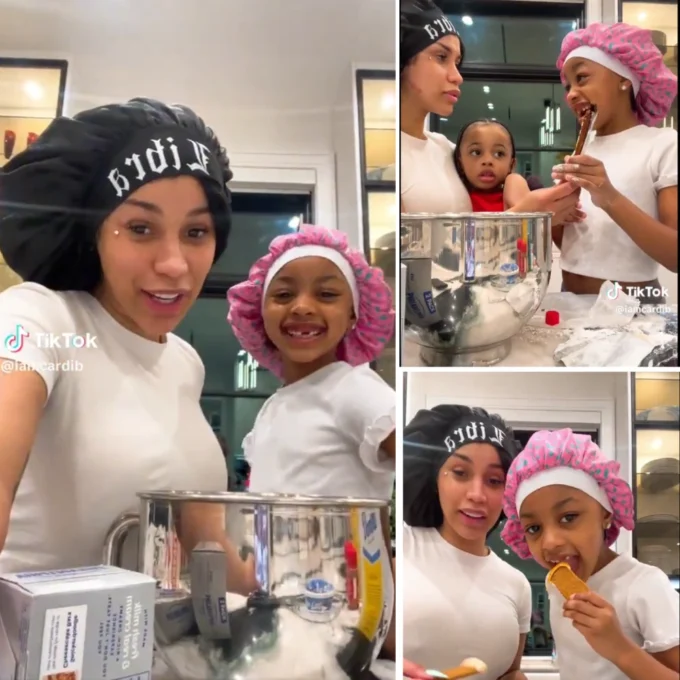
Cardi B has once again delighted fans with an adorable TikTok video featuring her 5-year-old daughter, Kulture. This time, the mother-daughter duo took to the kitchen to whip up a delicious cookie dip, and the internet couldn’t get enough of their sweet bonding moment.
The video quickly gained traction on social media and shows Cardi B and Kulture mixing ingredients while enjoying each other’s company. Dressed comfortably in their kitchen, the duo is seen playfully stirring the mixture and sneaking in little tastes along the way. At one point, Cardi humorously remarks,
“I love this cookie dip… with my gal KK ❤️… sorry didn’t save y’all none.”
Fans were quick to react, flooding the comments section with heartwarming messages.
One user wrote, “Imagine not liking Cardi and she’s just home making cookie dip with Kulture🥹️️❤️.” Another fan added, “This is the content we love! Cardi being a mom and having fun with her baby.”
While Cardi B is best known for her hit tracks and strong-willed nature, the rapper became popular through food content. Her Instagram and TikTok pages are now where most cooking moments are caught, where the rapper shares delicious recipes with her family.
In 2023, Cardi participated in the popular Spicy Bowl challenge and prepared a blistering dish, which drove the fans into a frenzy. The clip alone received over 4 million views and proved that Cardi’s cooking talent is just as impressive as her singing.
Despite her busy schedule as a global superstar, Cardi B never misses out on time with her kids. Whether throwing elaborate birthday parties or simply making them a snack, she ensures her children enjoy the best.
With her recent expansion into lifestyle content, it would not be surprising if Cardi B takes her food love one step further. Fans are already speculating about a cooking segment or a cookbook with some of her favorite home recipes.
For now, fans love every little bit of Cardi B and Kulture’s cute kitchen escapades. Based on her previous videos, we can anticipate further entertaining, family-oriented content.
Lil Durk and India Royale followers were provided with a warm and tender family moment when India Royale shared a video clip of Lil Durk braiding their daughter Willow Banks’ hair. The social media clip immediately took hearts by storm, showing a different side of the Chicago rapper—one not related to chart-topping hits or sell-out performances but a hands-on father.
In the clip, Durk carefully combs and styles Willow’s hair with clear focus as he patiently goes through the process. Willow, seemingly enjoying the attention from her dad, sits comfortably as Durk completes the task. India’s caption captured the affection for the moment and also increased fan love for the father-daughter relationship.
India Royale shares footage of Chicago rapper Lil Durk doing daughter Willow Banks’ hair ❤️ pic.twitter.com/1Z6A69F90z
Although Lil Durk is most famous in hip-hop for his strong lyrics and authoritative stage presence, moments such as these reveal his different side. The rapper, whose songs frequently explore the hardships of street life, loyalty, and self-improvement, has expressed openly for a while now how becoming a father transformed him.
Durk is a father of seven and has made family values his top priority regardless of the highs and lows he experiences. India Royale also highlighted his relationship with Willow through various social media posts. From birthday celebrations to peaceful home moments, the two have constantly given fans a peek into their family life.
via- x
Lil Durk and India Royale’s relationship has been the most talked-about within the hip-hop community. The two got into a relationship around 2017 and have had their fair share of highs and lows. The two publicly courted one another for years before the two became engaged back in 2021 when Durk proposed while performing in Chicago. The fans were thrilled with the union and felt the two were here for the long haul.
Their relationship was also plagued by drama during 2022 and 2023, with break-up and infidelity rumors taking the headlines. The two have remained close despite their break-up, with most communication through their love for Willow. Durk’s public words generally indicate his desire for reconciliation, but India has remained focused on co-parenting.
While their status may be complicated, one thing’s for sure: India and Durk know the power of rapport—between the two and their fans. India Royale, a social media influencer and entrepreneur, has built a brand around her life, sharing everything from makeup tutorials to family moments. She is acutely aware of what her fans are obsessed with—genuine, authentic content.
As soon as India posted the clip, social media reacted positively. The fans flooded the comments with their appreciation for Durk for being such an involved father. Most referenced how rare it was to see a rapper so openly engaged with fatherhood, defying the stereotyping around hip-hop culture and fatherhood.
One fan wrote, “This is the kind of content we love. Black fathers appear and love.” Another wrote, “Durk is really a girl dad. Willow got him around her little finger.”
This is not simply a heart-warming father-daughter moment—it is a reminder of the importance of presence, no matter how crazy life gets. Whether side by side or separated by distance, India and Durk’s dedication to Willow is clear, reminding us that love and family come first.
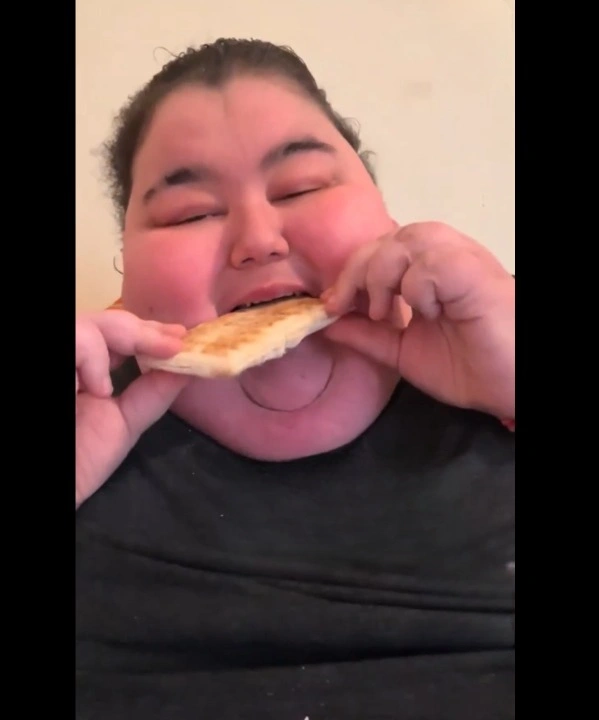
Kültür gained a massive following with his “mukbang” videos, a worldwide trend in which YouTubers consume gigantic amounts of food while interacting with their viewers. Mukbang started in South Korea but gained popularity worldwide, although it also gained attention for potentially promoting bad eating habits. Kültür’s videos, in which he consumed gigantic amounts of food during one sitting, captivated viewers but took a horrible toll on his health.
New York Post reports suggest Kültür had grappled with severe medical issues for several months. He spent weeks in the hospital before his death, unable to walk and requiring the support of machines to breathe. His condition, directly caused by obesity, was also made worse by eating binges for content for many years. An Indian Times report confirmed the tragic destiny of his medical problems, noting the 24-year-old’s rapid decline.
Kültür’s family released a poignant statement reflecting on his life and legacy.
“Efecan was a kind and loving person, but his passion for creating content led him down a dangerous path,”
they said.
“We hope his story encourages others to prioritize their health and seek help if they struggle with similar issues.”
Their words highlight the personal loss and a broader call for awareness.
The rise of mukbang has sparked debate among health experts, who caution against its impact. Dr. Jane Smith, a nutritionist, explained,
“While these videos might seem like harmless entertainment, they can normalize binge eating, a serious disorder with real consequences like obesity, diabetes, and heart disease.”
Support is available through resources like the National Eating Disorders Association, which offers guidance for individuals and families.
Kültür’s death at such a young age has left fans and followers reeling while prompting calls for social media platforms to address content that may glamorize harmful behaviors. His story is a stark reminder of the hidden costs behind the pursuit of online fame.
🚨 A new documentary titled "Stan Lee: The Final Chapter" is set to shed light on the darker aspects of the Marvel legend's final years. Directed by Jon Bolerjack, who closely worked with Lee during his last four years, the film reveals how Lee was exploited by those around him,… pic.twitter.com/D4Fo8cpJj8
The film, currently crowdfunding via Kickstarter with the aim of raising funds, promises to shed the veil from the darker side of Lee’s life towards the end. Bolerjack stated that the documentary will expose how Lee’s poor health became a source of enrichment for the ones around him. He made a lot of money during the conventions, where he participated in autograph and photograph sessions, but the money rarely found its way into Lee’s pockets or his relatives.
One central figure in this story is Keya Morgan, who was Lee’s business manager and caretaker for a time. Morgan became embroiled in legal trouble over allegations of elder abuse, facing charges like theft and false imprisonment. Although those charges were eventually dropped after a jury couldn’t reach a verdict, the documentary promises to explore Morgan’s role and influence on Lee in depth.
The documentary doesn’t stop at accusations. It also features interviews with prominent comic book creators, including Rob Liefeld and Roy Thomas, who provide firsthand insights into Lee’s mistreatment. Their accounts help paint a fuller picture of a man adored by millions but betrayed by some of those closest to him in his twilight years.
Jon Bolerjack calls the film a “rollercoaster of drama and duplicity,” a promise that’s teased in the trailer, which you can watch on YouTube. The footage offers an emotional sneak peek at the revelations awaiting viewers. With the Kickstarter campaign gaining traction, the team expects to release the documentary before the end of 2025. Bolerjack has already poured significant resources into the project and is rallying support to complete it.
Beyond telling Stan Lee’s story, “Stan Lee: The Final Chapter” seeks to shine a spotlight on elder abuse, an issue that extends far beyond the Marvel comic book world. The filmmakers hope to honor Lee’s incredible legacy while sparking conversations that could help protect others from similar exploitation in the future.